
SIMON
OSTROVSKY
REPORTER PRODUCER DIRECTOR


LATEST
2026
Sep
19
reporting
Why Is the NHL Ignoring Ovechkin’s Pro-Putin Ad?
2026
Sep
8
reporting
How to survive a drone attack in Ukraine
2026
Sep
6
reporting
Meet the founder of Ukraine’s 3D Printing Army



AWARDS


DOCUMENTARIES
7 EPISODES

PBS
WATCH
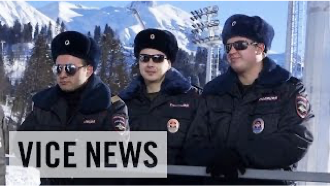
THE MOST EXPENSIVE OLYMPICS IN THE WORLD
PUBLIC
SPEAKING
CUSTOMIZED IN CONTENTFUL


FAQ
ABOUT&CONTACT

PBS NewsHour Special Correspondent
2025-26 Religion News Association award-winner
info@simonostrovsky.com
Download hi-res photos
"Remarkable dispatches
from Ukraine"
- David Carr, The New York Times
"One of the most intREpid
journalists"
I’m Simon Ostrovsky, an award-winning journalist and documentary filmmaker and I've spent much of my career reporting from conflict zones and authoritarian countries. I’m currently a Special Correspondent for PBS NewsHour covering Ukraine and Russia. Previously, I was a correspondent for VICE News, where I created and reported Russian Roulette, the documentary series that followed Russia’s intervention in Ukraine from its beginning.
My reporting has taken me to front lines, occupied territories and places where getting to the story is often the hardest part of telling it. I’ve always believed there’s no substitute for being there: talking to the people involved, seeing what’s happening for yourself, checking what you’re told and coming back with something the audience didn’t already know.
If you’re looking for good coverage of Ukraine, Russia, Eastern Europe and the former Soviet Union, follow me on YouTube and Substack—I’ve been covering the region for more than two decades and have built a reputation for reporting from the ground rather than from a distance.
Why YouTube and Substack?
There’s more news being posted on the internet than ever before. But a lot of it isn’t actually reporting. It’s people sitting in front of cameras talking about reporting that somebody else paid to produce. There’s nothing inherently wrong with commentary, but somebody still has to do the expensive part: get on a plane, go to the place, find the people who actually know what happened, hire good local producers, ask difficult questions, check the answers and come back with something we didn’t already know. Increasingly, the news business is having trouble paying for that kind of work.
That’s why I’ve launched my own YouTube channel and Substack. I want to see if I can use the same internet economy that has disrupted traditional news to help finance actual reporting. The idea is pretty straightforward: if you can support my work through a subscription on Substack, I’ll put that money back into the journalism—travel, local producers, camera crews, investigations and documentaries. I don’t want to sit at home and tell you what I think about whatever everyone is arguing about that day. I want to go places, talk to people, find things out and show you what I found.
The internet itself isn’t the problem. In fact, it’s a big part of how my reporting first reached a large audience. The problem is that we’ve built an online news economy where it can be easier to make money talking about other people’s reporting than paying for the reporting itself. I’d like to see if we can flip that around.
YouTube is where I’ll publish my video reporting—dispatches, investigations, documentaries and stories from the field. Substack is where I’ll write directly to readers, share what I’m working on and take you behind the scenes of how the reporting gets done. Some stories will be quick. Others may take months. But the basic idea is the same: don’t just post about the story. Go there.
- Savannah Guthrie, Today show, NBC
"Everyone should chill
the fuck out"
- John Oliver, Last Week Tonight, HBO
© 2023-2026 Simon Ostrovsky
